Retracing the Benge Detachment: Preserving a Cherokee Trail of Tears Route Through Missouri
Rusty Weisman Explores the Journey of Chief John Benge’s Detachment Through Historical Research and Field Investigation
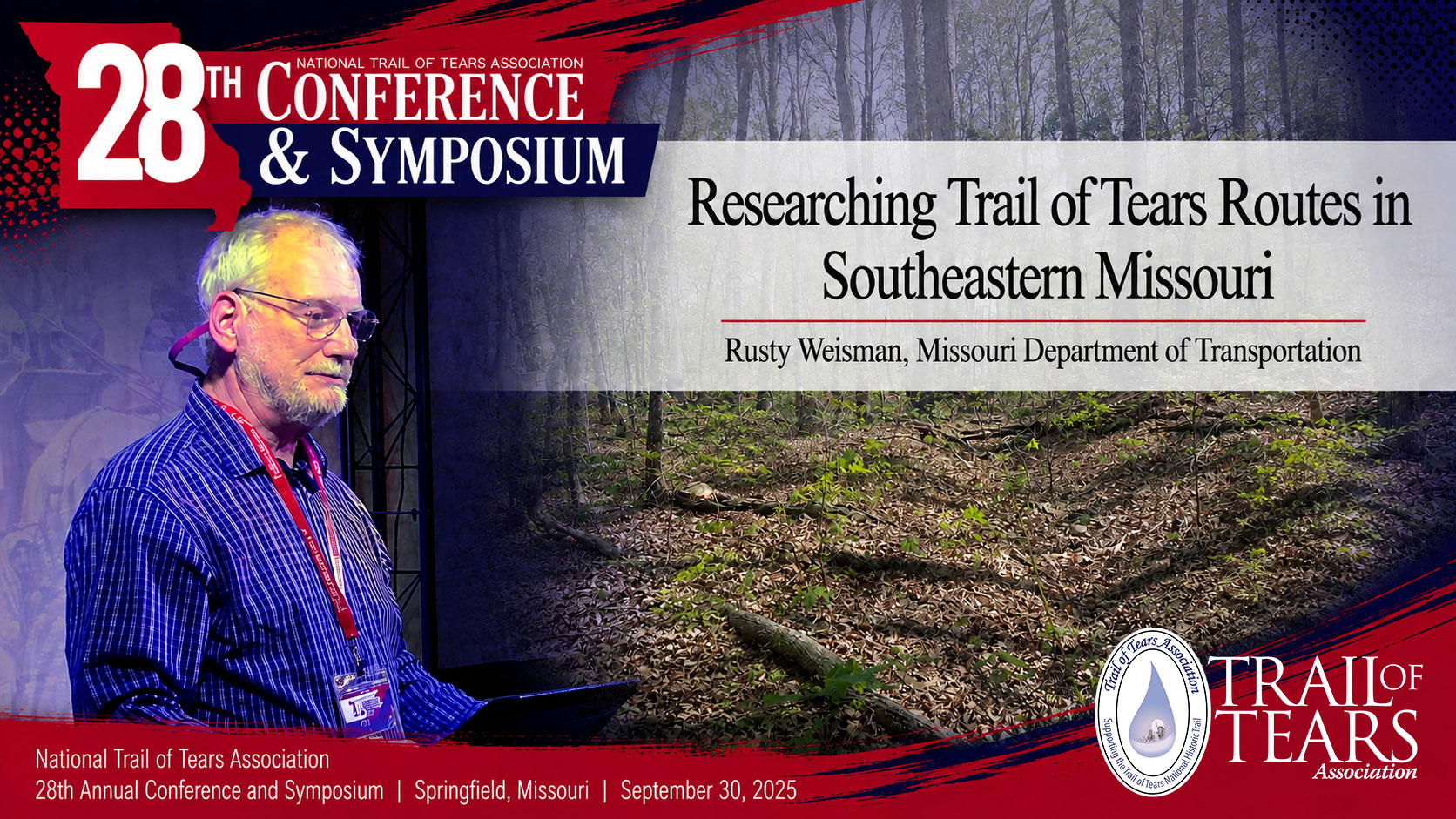
Presented by Rusty Weisman Retired Missouri Department of Transportation State Roadway Historian
28th National Trail of Tears Association Conference & Symposium
Following the Footsteps of the Benge Detachment
The Trail of Tears was not a single caravan traveling a single road. Instead, it consisted of numerous detachments, each following its own route under unique circumstances as thousands of Cherokee men, women, and children were forced from their ancestral homeland to Indian Territory.
One of those groups was the Benge Detachment, led by Chief John Benge.
During his second presentation at the 28th National Trail of Tears Association Conference & Symposium, Rusty Weisman shared the story of this remarkable detachment while demonstrating how decades of historical research, transportation history, cartography, and field investigation have helped identify and preserve portions of its route across southeastern Missouri.
His presentation revealed that understanding the Trail of Tears requires more than reading historical accounts—it requires rediscovering the very landscapes where history unfolded.
Who Was Chief John Benge?
Chief John Benge served as the conductor of one of the Cherokee detachments that traveled west during the forced removal of 1838–1839.
Like the leaders of the other detachments, Benge bore enormous responsibility. He was charged with guiding hundreds of Cherokee citizens across unfamiliar terrain while enduring harsh weather, illness, limited supplies, and the emotional burden of forced exile.
Although each detachment experienced removal differently, together they represent the collective story remembered today as the Trail of Tears.
Weisman explained that understanding the experiences of individual detachments helps historians move beyond generalized narratives and appreciate the human dimension of removal.
Reconstructing a Forgotten Route
Nearly two centuries later, much of the Benge Detachment’s path has disappeared beneath farms, forests, county roads, and modern highways.
Rediscovering that route requires careful historical detective work.
Throughout the presentation, Weisman demonstrated how researchers compare nineteenth-century maps, military records, government surveys, land plats, travelers’ journals, archaeological evidence, and transportation records to reconstruct where the Benge Detachment traveled through Missouri.
Each historical source contributes another piece of the puzzle.
When combined, these documents reveal a remarkably detailed picture of the route followed by Cherokee families during one of the most difficult journeys in their history.
Missouri’s Critical Role in the Trail of Tears
Missouri occupies a unique place within the history of Indian Removal.
Its rivers, rolling hills, established roadways, and river crossings made it a vital transportation corridor for Cherokee detachments traveling west.
The Benge Detachment passed through portions of southeastern Missouri, where natural geography largely determined the roads available to travelers.
Weisman illustrated how understanding Missouri’s transportation network provides important context for interpreting the Trail of Tears today.
Many roads still in use follow corridors established long before statehood, preserving traces of journeys that occurred generations ago.
Reading the Landscape
One of the most fascinating aspects of Weisman’s work is his ability to “read” the landscape.
Historic roads often leave subtle clues that remain visible long after they have disappeared from official maps.
Old wagon cuts, abandoned roadbeds, creek crossings, stone culverts, ridgelines, and remnants of early transportation corridors all help researchers confirm documentary evidence.
By combining archival research with on-site investigation, Weisman has been able to identify locations where the Benge Detachment likely traveled, allowing historians to connect written records with the physical landscape.
This process transforms historical research into an active exploration of place.
Why Individual Detachments Matter
The Trail of Tears is often remembered as one event.
Weisman encouraged attendees to think differently.
Each Cherokee detachment had its own leaders, timelines, challenges, and experiences. Studying these individual groups helps historians better understand the diversity of experiences during removal.
The story of the Benge Detachment reminds us that removal was not simply a political policy.
It was a series of deeply personal journeys experienced by thousands of individuals and families.
By preserving the routes of specific detachments, historians ensure those individual stories are not lost within broader historical narratives.
Preservation Through Partnership
Weisman emphasized that preserving Trail of Tears routes requires cooperation among many organizations.
State transportation agencies, tribal historians, archaeologists, local historical societies, preservation organizations, and the National Trail of Tears Association all contribute valuable expertise.
These partnerships have made it possible to identify historic corridors, install interpretive markers, document archaeological resources, and educate the public about places that might otherwise remain unknown.
The Benge Detachment route stands as an example of what collaborative historical preservation can accomplish.
Connecting the Past With the Present
Although the events of the Trail of Tears occurred nearly two centuries ago, the landscapes remain.
Many modern travelers unknowingly drive roads that parallel—or in some cases overlap—the routes once traveled by Cherokee detachments.
Recognizing these connections changes the way we experience Missouri’s landscape.
Roads become historical witnesses.
Creek crossings become places of remembrance.
Ordinary countryside becomes part of one of America’s most significant historical stories.
Through careful research, Weisman helps restore that perspective.
Preserving More Than a Route
Rusty Weisman’s presentation ultimately demonstrates that preserving the Benge Detachment route is about much more than identifying an old road.
It is about honoring the Cherokee families who endured forced removal, preserving evidence of their journey, and ensuring future generations can better understand both the tragedy and resilience that define the Trail of Tears.
Every newly documented mile adds another chapter to the historical record.
Every preserved corridor helps keep the memory of the Cherokee people alive within the very landscapes they once crossed.
By retracing the Benge Detachment, Weisman reminds us that history is not confined to books and archives.
It still exists beneath our feet, waiting to be recognized, protected, and remembered.
About the Presenter
Rusty Weisman is the retired State Roadway Historian for the Missouri Department of Transportation (MoDOT). Throughout his career, he specialized in documenting Missouri’s historic transportation network and became one of the leading researchers of Trail of Tears routes across the state. His work combines historical cartography, archival research, transportation history, archaeology, and field investigation to preserve the routes traveled by Cherokee detachments during removal.
Rusty Weisman Explores the Journey of Chief John Benge’s Detachment Through Historical Research and Field Investigation Presented by Rusty WeismanRetired Missouri Department of Transportation State Roadway Historian 28th National Trail of Tears Association Conference & Symposium Following the Footsteps of the Benge Detachment The Trail of Tears was not a