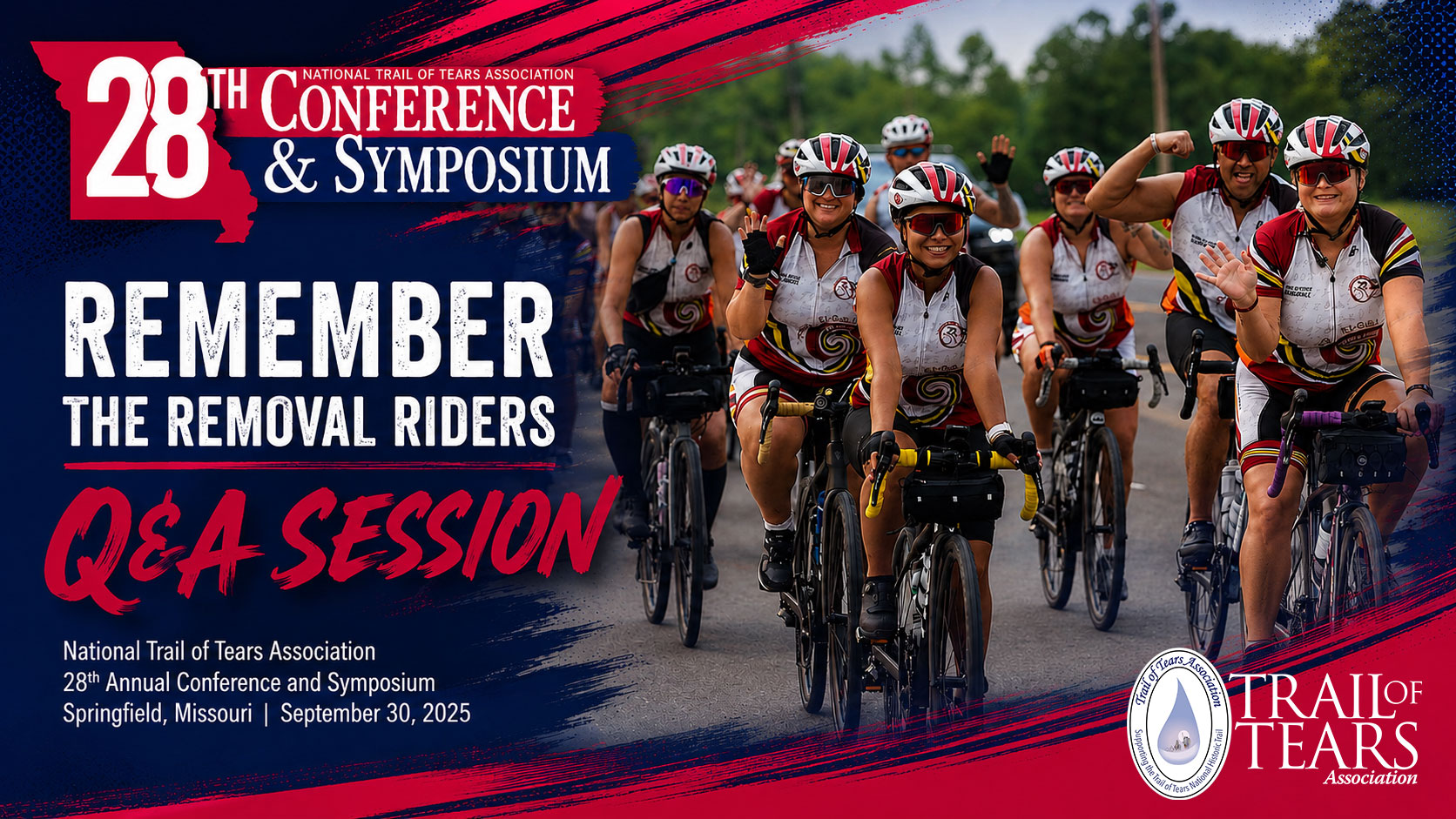
Presented at the 28th National Trail of Tears Association Conference & Symposium
Featuring members of the Cherokee Nation’s Remember the Removal Bike Ride program, moderated by Heather Fight Dogwidau, Youth Leadership Manager for Cherokee Nation Education Services.
Remembering the Past by Riding It
History is often learned through books, museums, and historical markers. For participants in the Cherokee Nation’s Remember the Removal Bike Ride, history is experienced one mile at a time.
During this special panel discussion at the 28th National Trail of Tears Association Conference & Symposium, attendees heard directly from several young Cherokee leaders whose lives have been shaped by participating in one of the Nation’s most meaningful youth leadership programs.
Moderated by Heather Fight Dogwidau, Youth Leadership Manager for Cherokee Nation Education Services, the discussion featured current and former riders who shared their personal experiences retracing portions of the Northern Route of the Trail of Tears by bicycle—a journey that transforms history from something studied into something deeply felt.
More Than a Bike Ride
Heather Fight Dogwidau opened the session by introducing the audience to Cherokee Nation’s Youth Leadership programs and explaining how the Remember the Removal Bike Ride fits within a broader effort to develop future tribal leaders.
Joining her on stage were several riders from the 2024 and 2025 programs, including Hannah Nugent, the 2025–2026 Miss Cherokee and a 2024 rider, along with other recent participants who represented the next generation of Cherokee leadership.
While many people view the program as an athletic challenge, the panelists emphasized that cycling hundreds of miles is only one part of the experience.
The ride is ultimately about understanding family history, Cherokee resilience, and the responsibility each participant carries in preserving that story for future generations.
Following the Footsteps of Their Ancestors
Each summer, selected Cherokee youth retrace the removal route traveled by their ancestors nearly two centuries ago.
Along the way, riders stop at significant historical sites, cemeteries, river crossings, mission locations, and former Cherokee settlements. Historians, cultural educators, language speakers, and tribal leaders provide context that helps participants understand what occurred at each location.
For many riders, these places are no longer simply names on a map.
They become sacred places connected to real people whose perseverance made the modern Cherokee Nation possible.
Several panelists reflected on the emotional weight of standing where their ancestors once stood and realizing that every mile ridden represents unimaginable hardship endured by Cherokee families during removal.
Building Leaders Through Shared Challenge
Although the historical education is central to the program, participants repeatedly described another unexpected outcome: the relationships built among riders.
Training together, overcoming physical exhaustion, encouraging one another during difficult stretches, and living together for weeks creates lifelong friendships.
Those shared experiences also develop leadership skills.
Participants spoke about learning accountability, teamwork, communication, and perseverance—qualities that continue influencing their education, careers, and service to their communities long after the ride ends.
The experience often changes how riders see themselves and their responsibilities as Cherokee citizens.
Carrying Cherokee Culture Forward
Throughout the discussion, the riders emphasized that Remember the Removal is not only about remembering tragedy.
It is equally about celebrating survival.
Participants described how the program strengthened their appreciation for Cherokee language, traditions, community, and identity.
For some, the ride inspired greater involvement in tribal leadership.
Others became passionate about preserving history, educating younger students, or serving as ambassadors for Cherokee Nation.
Hannah Nugent, who later became Miss Cherokee, exemplifies how the program prepares young people to become visible representatives of their Nation.
Connecting Past and Present
Audience members heard how retracing the Trail of Tears creates a powerful connection between historical events and present-day Cherokee life.
Rather than viewing removal as a distant chapter in American history, riders come to understand it as a story that continues to shape Cherokee families today.
That perspective deepens appreciation not only for the sacrifices of previous generations but also for the resilience that allowed Cherokee culture to flourish despite extraordinary adversity.
Inspiring Future Participants
One of the strongest themes throughout the discussion was encouragement.
The panelists urged eligible Cherokee youth to consider applying for the Remember the Removal Bike Ride, acknowledging that the journey is physically demanding but describing it as one of the most rewarding experiences of their lives.
They emphasized that participants finish the program with far more than cycling accomplishments—they gain confidence, lifelong friendships, leadership skills, and a deeper understanding of their identity and heritage.
A Living Legacy
The Remember the Removal Bike Ride continues to serve as one of Cherokee Nation’s most significant youth leadership initiatives because it combines history, education, physical endurance, and cultural preservation into a single transformative experience.
As the panel demonstrated, the program does more than teach history.
It develops young leaders who carry that history forward.
Their stories remind audiences that the Trail of Tears is not merely a historical event to be remembered each year. It is a living legacy that continues to inspire resilience, service, and leadership among new generations of Cherokee citizens.